Why do children love playing with toy police cars? The answer often begins with a small detail: a flashing light, a rolling wheel, or a siren sound they can imitate. These toys let children create a story they can control. One moment, a car races past a block tower; the next, it stops beside a toy figure who needs help. The play can turn ordinary objects into a busy city. Small cars matter.
Child-development educator Fred Rogers observed, “Play is often talked about as if it were a relief from serious learning. But for children, play is serious learning.” A toy police car can invite pretend roles, simple problem-solving, and conversations about helping others. Children may practice taking turns, making up events, or deciding what happens next. Their stories do not need to match real life perfectly. Sometimes the siren is simply fun. And not every child is drawn to police themes; interests vary, and a toy’s appeal may come from its color, movement, or sound. Adults can learn more by watching how a child plays than by assuming what the toy means. A closer look at these everyday play moments helps explain why do children love playing with toy police cars—and what they may be exploring as they play.
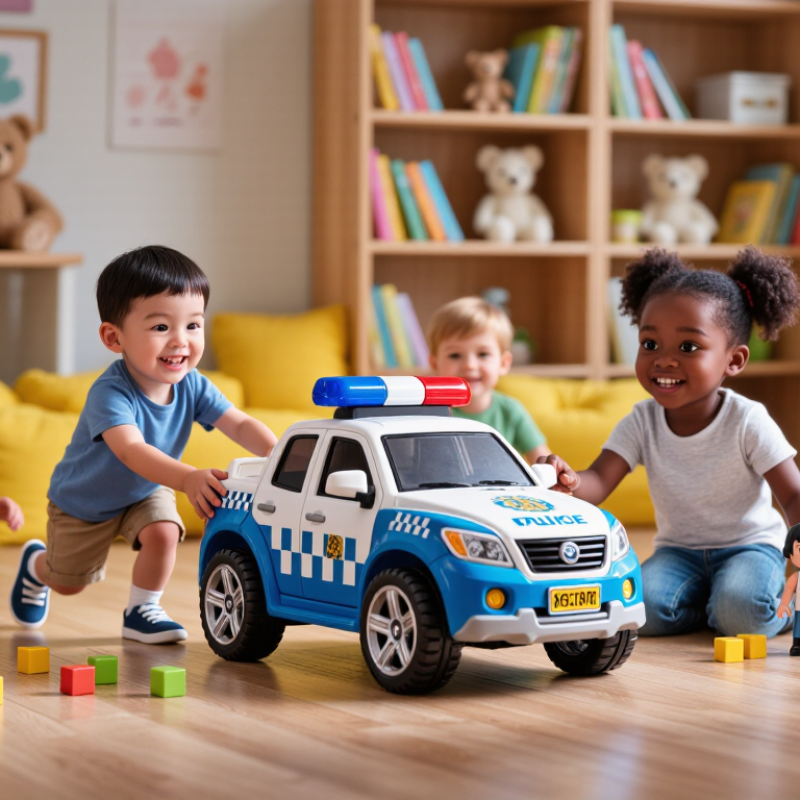
Toy police cars are small play vehicles modeled on patrol cars, usually with a marked body, roof lights, and rolling wheels. Some include doors that open, simple sound buttons, or a miniature figure. Others keep the design plain, leaving children to invent the people and events around the car. The toy is not a working vehicle. It is a prop for storytelling, sorting, and hands-on exploration.
Design choices shape how a car feels in a child’s hands. A sturdy body and smooth, rounded edges help it withstand everyday play. Large wheels can roll across carpet seams, while a low roof light is less likely to snag during handling. Bright colors and clear markings make the vehicle easy to recognize, but tiny printed details may wear away. Small details matter. Sound features should be easy to operate and not overwhelming; quiet play can be just as engaging.
A thoughtful toy balances recognizable features with room for imagination. If every button dictates what happens, children may have fewer chances to create their own scenes. That balance matters. Caregivers can check the suggested age range, inspect small detachable parts, and choose a size that suits the child’s grip. In practice, the simplest car may inspire the longest game.
A toy police car combines a familiar vehicle shape with recognizable features for imaginative rescue and community-helper play.
Example design component counts: one body shell, four wheels, two axles, one light bar, and one sound unit. This is a simple model of a toy design, not a survey of products or children’s preferences. Lights and sounds are optional features.
Why Police Cars Attract Children's Attention
Toy police cars combine bold colors, familiar sounds, and clear roles. A small blue-and-white vehicle can turn a living-room rug into a busy street. Children can push it, park it, or invent a rescue scene. The play is easy to start, yet every story can change. That freedom matters: the LEGO Foundation’s research on learning through play describes play as supporting children’s social, emotional, and thinking skills. A toy car also gives little hands something concrete to control. There is a small catch: flashing lights and sirens may excite some children, but overwhelm others.
The design catches the eye quickly. Contrasting colors, rotating wheels, and a light bar offer simple details to notice and explore. Familiar police-car imagery also helps children copy everyday scenes they have seen in books or on the street. Common Sense Media’s 2020 Census reported that U.S. children ages zero to eight spent an average of about two and a half hours daily with screen media. That finding does not prove screen time causes a preference for toy cars, but it highlights the appeal of hands-on play away from a display. Even so, every child responds differently.
Tips: Choose a sturdy car with smooth edges and a comfortable size. Invite your child to create a calm story, such as helping a lost toy find its way home. Follow their lead; not every play session needs a lesson.
A toy police car can turn a living-room rug into a busy town. A child might steer around a cushion, stop at a block-built bridge, and invent a reason for the delay. “The road is flooded,” they may announce, then send the car down a new route. Small details matter: a cardboard box becomes a station, while a blanket becomes a hill. The child is not just moving a toy; they are building a sequence of events and choosing what happens next. UNICEF’s early-childhood guidance reports that about 90% of brain development takes place before age five. That figure describes a period of rapid growth, not a guarantee that one toy will create a particular skill.
The American Academy of Pediatrics’ 2018 clinical report, “The Power of Play,” describes play as supporting language, social-emotional development, and self-regulation. A pretend rescue story gives children a reason to practice words, explain a problem, and listen to another person’s idea. An adult can extend the story with a gentle question: “What does the driver see?” Then leave space for the child’s answer. Keep it flexible. Sometimes the car just circles the sofa, and the story goes nowhere in particular. That is still play, though adults may need to resist taking over and supplying every plot twist.
| Play Element | What a Child Might Do | How It Can Support Play and Learning | A Helpful Adult Prompt |
|---|---|---|---|
| Inventing a mission | Decide that the car is responding to a lost pet, a blocked road, or another make-believe situation. | Creating a mission gives the child a starting point for an original story and encourages imaginative thinking. | “What has happened, and where is the car going?” |
| Building a sequence of events | Describe the car arriving, investigating, and helping solve the pretend problem. | Putting events in order offers practice with story structure and expressing what happens next. | “What happened first? What might happen after that?” |
| Creating characters and dialogue | Give the driver, passengers, or other toys different roles and voices. | Speaking for characters can encourage vocabulary use, conversation, and creative expression. | “What does the driver say to the person who needs help?” |
| Exploring different viewpoints | Imagine what different characters know, need, or feel during the story. | Taking on roles provides opportunities to think about perspectives and respond to a character’s situation. | “How might each character feel about what happened?” |
| Solving pretend problems | Work out how the toy car can reach a destination or help resolve a make-believe challenge. | Choosing what to try next gives children opportunities to plan, make decisions, and adjust their ideas. | “What could the characters try next?” |
| Playing together | Share roles, take turns adding ideas, and agree on what happens in the story. | When play is shared, children can practice listening, cooperation, and negotiating story ideas. | “Which role would you like, and what role could your partner choose?” |
| Making the story their own | Change the setting, add a new character, or invent an unexpected ending. | Changing story details lets children explore possibilities and practice flexible, creative thinking. | “What could change the direction of the story?” |
Note: These are examples of possible pretend-play activities, not guaranteed outcomes. Children’s play interests and storytelling abilities vary.
A toy police car can turn a rug into a busy street. Children make it stop, turn, and respond to pretend emergencies. While doing so, they practise sequencing, spatial reasoning, and storytelling. “The car is blocking the bridge,” a child might say, then move another vehicle to make room. Small scenes matter.
The American Academy of Pediatrics’ 2018 clinical report, “The Power of Play,” describes play as supporting language, social-emotional skills, and executive function. These skills appear in simple moments: taking turns, explaining a route, or changing a plan when the car tips over. UNICEF’s 2018 Learning through Play report notes that about 90% of brain development occurs before age five. That figure is useful context, not proof that one toy causes learning.
Pretend police play can also invite conversations about helping, safety, and community roles. An adult might ask, “Who needs help here?” and let the child shape the answer. It is tempting to call every chase a lesson; that overstates the case. Sometimes the child only wants the car to go fast. That takes practice, too. Parents can observe, ask gentle questions, and avoid correcting every detail, while remembering that pretend play is not a substitute for real-world safety guidance.
A toy police car offers different pleasures at different ages. For a toddler, the appeal may be simple: bright lights, rolling wheels, and a satisfying click when a door opens. Pushing it across a rug gives a child a clear cause-and-effect lesson. The car moves because their hand moves it. Small victories count.
As children grow, play often becomes more imaginative. A preschooler might send the car around a sofa-leg “corner,” stop beside a block-built station, and invent a rescue for a stuffed animal. The vehicle becomes a character, not just a toy. Older children may prefer planning routes, assigning roles, or creating rules for a whole pretend town. Their interest can shift from the car itself to the story they build around it.
Preferences still vary widely. Some children enjoy realistic details, such as doors that open or a steering wheel that turns. Others care more about speed, sound, or making up funny scenes. A quieter child may play alone, while a sibling turns the same car into part of a shared adventure. Not every child agrees.
Adults can follow the child’s lead, ask what is happening in the scene, and leave room for unexpected answers. I may be overreading a simple toy sometimes; children’s reasons for choosing it can change from one afternoon to the next.
High-contrast colors, rolling wheels, and a light bar offer details to notice. Sirens may excite some children, but overwhelm others.
A rug can become a road, a cushion a hill, and a box a station. Children decide what happens next.
They may practise storytelling, sequencing, spatial reasoning, and taking turns. One toy cannot guarantee a particular skill.
Ask a gentle question, such as, “What does the driver see?” Then wait. Let the child lead.
The car can help a lost toy find its way home. Keep the scene calm and let your child add details.
No. Sometimes the car just circles the sofa or races across the rug. That is enough.
Choose a sturdy car with smooth edges and a comfortable size. Check whether lights or sounds feel too intense.
No. Play can support language and social-emotional skills, but one toy does not cause a specific outcome. It is easy to overstate what a small car can do.
Toy police cars are small play vehicles designed with recognizable features such as bright colors, flashing lights, and sturdy shapes that are easy for children to handle. These details catch a child’s attention and make the cars feel exciting and easy to imagine in action. Many parents wonder why do children love playing with toy police cars: the vehicles invite children to create their own stories, from helping a neighbor to guiding traffic or responding to an imaginary call.
Through pretend play, children can take on different roles, invent characters, and build scenes with friends or family. This kind of play can encourage imagination, storytelling, communication, and cooperation. Children may also practice problem-solving as they decide what happens next in a story. The appeal can change with age and personal interests: younger children may enjoy moving the cars and exploring their features, while older children may create more detailed adventures and scenarios.

Hoopla Toys