Choosing among China’s top 10 slot car racing sets requires more than comparing track length, car speed, or price. Parents often ask, “what age is appropriate for slot car racing sets?” The honest answer depends on design, supervision, and a child’s coordination. A fast car can leave the track within seconds. Tiny connectors can also frustrate younger players.
Circana’s 2024 Global Toy Report highlights continuing demand for toys that provide longer-lasting, interactive play. The Toy Association’s 2024 industry research also emphasizes family engagement, developmental value, and age-appropriate design. These findings support a practical approach. Simple battery-powered sets may suit children around six years old. More complex systems often fit older children, especially when assembly, speed control, and troubleshooting are involved.
Dr. Amanda Gummer, founder of The Good Play Guide, says, “Age recommendations are a guide, not a guarantee of suitability.” Her point matters here. A labeled age range cannot measure every child’s patience or hand control. A confident seven-year-old may manage a beginner circuit well. Another child may need help until age nine. This is not a perfect formula. Parents should inspect small parts, read the manufacturer’s guidance, and watch the first race. The safest choice is usually the set that encourages shared play without overwhelming the child. This guide compares China’s leading options through that practical lens, combining product features, reported industry trends, and real-world usability.
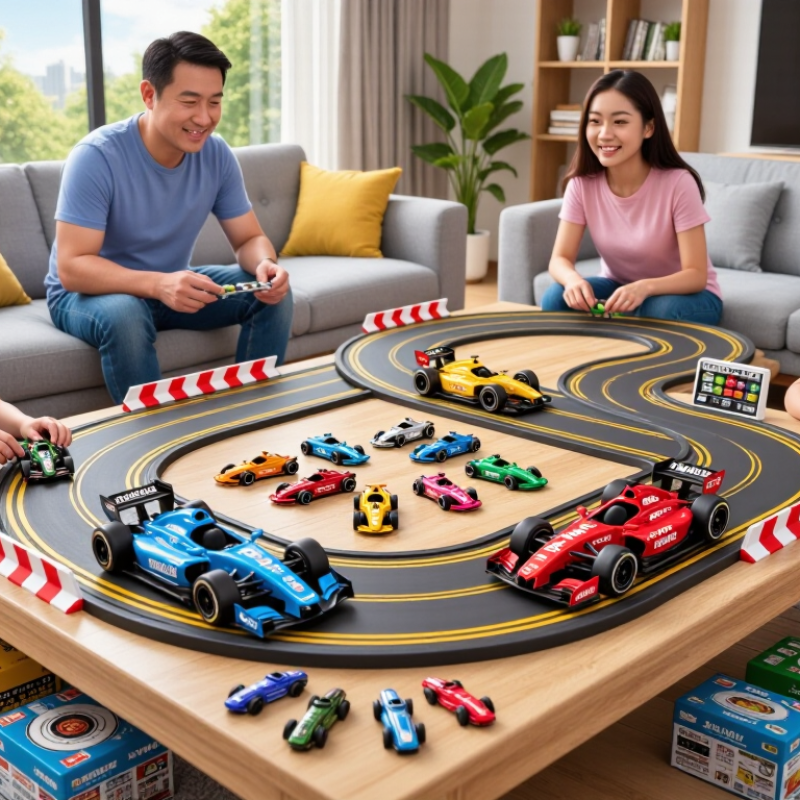
Slot car racing is a hands-on race system using small electric cars, grooved tracks, and handheld controllers. Metal rails carry low-voltage electricity to each car’s motor. A guide pin keeps the car inside its lane, while the trigger controls speed. Press too hard, and the car shoots off at the corner. Release slightly, and it stays balanced. The process teaches timing, coordination, and simple mechanical thinking through repeated practice.
Most children can begin with a basic set around age six, when they can follow track layouts and control a trigger safely. More detailed layouts usually suit children aged eight and above. The Toy Association and Circana reported that global toy sales reached about 108.7 billion dollars in 2023, showing the scale of play-based learning products. However, this figure covers all toy categories, not slot racing alone. That limitation matters. Age labels are useful, but they are not perfect. A careful six-year-old may outperform an impatient ten-year-old. Track length, car speed, small parts, and adult supervision also change the experience. A beginner needs visible lane connections, sturdy track pieces, and short races. Keep it simple. Some children may lose interest after a few crashes, while others will adjust the controller for hours. That difference is easy to underestimate.
Slot car racing uses small electrically powered cars that follow a grooved track. Conductive rails supply power, while a hand controller regulates the car's speed. The table below compares common slot car racing set configurations by age suitability, track design, operating requirements, and learning level. Specifications are typical ranges for this type of product and may vary by individual set.
| Rank | Set Configuration | Recommended Age | Typical Track Length | Cars | Power System | Control Type | Learning Level | Best Use | Important Safety Consideration |
|---|---|---|---|---|---|---|---|---|---|
| 1 | Large-Scale Beginner Circuit | 6+ years | 5–8 m | 2 | Low-voltage DC | Hand throttle | Easy | First-time racers and family play | Adult supervision is recommended; keep loose parts away from children under three. |
| 2 | Compact Oval Track | 5+ years | 3–5 m | 2 | Low-voltage DC | Hand throttle | Easy | Small rooms and short races | Place the track on a stable, level surface to prevent cars from leaving the rails. |
| 3 | Figure-Eight Starter Set | 6+ years | 4–7 m | 2 | Low-voltage DC | Hand throttle | Easy–Moderate | Learning braking and corner control | Crossing sections require careful assembly and regular inspection of track connections. |
| 4 | Speed-Control Training Circuit | 7+ years | 5–8 m | 2 | Adjustable DC | Variable-speed hand throttle | Moderate | Practising smooth acceleration and braking | Use only the supplied power unit and follow its electrical specifications. |
| 5 | Technical Corner Challenge | 8+ years | 6–10 m | 2 | Adjustable DC | Hand throttle | Moderate | Developing racing lines and throttle timing | Check that cars and guide pins are correctly seated before increasing speed. |
| 6 | Long Straightaway Sprint Layout | 8+ years | 8–12 m | 2 | Adjustable DC | Hand throttle | Moderate | Straight-line speed and reaction practice | Leave clear space around the layout because cars may deslot at higher speeds. |
| 7 | Modular Expansion Circuit | 8+ years | 7–15 m | 2 | Low-voltage DC | Hand throttle | Moderate | Families that want to add track sections later | Use compatible track sections and avoid overloading the power supply. |
| 8 | Lap-Counting Practice Layout | 9+ years | 8–14 m | 2 | Low-voltage DC | Hand throttle with manual timing | Moderate | Timed races and basic competition rules | Keep timing devices and cables away from the racing surface and walking paths. |
| 9 | Digital Passing and Lane-Change Circuit | 10+ years | 8–15 m | 2–4 | Digital control unit | Electronic controller | Advanced | Multi-car racing and strategic passing | Digital track parts must be installed in the correct direction and kept dry. |
| 10 | Advanced Club-Style Circuit | 12+ years | 12–25 m | 2–6 | Regulated DC or digital | Advanced electronic control | Advanced | Serious practice, organized races, and track customization | Set up in a dedicated area and inspect electrical connections before every session. |
Six to eight years is a practical starting range for many children. Age labels are not perfect. Attention span and impulse control matter too.
Usually not, especially when the set contains small replacement parts. Tiny pieces can become choking hazards. Choose large, sturdy components instead.
Use a flat floor or a sturdy table. Secure loose wires and keep drinks away from electrical parts. Avoid furniture edges and crowded walkways.
Choose gentle speeds, simple controls, and large track pieces. Avoid tiny scenery, loose guide pins, and complicated layouts. Keep the setup close and visible.
Simple two-controller sets with wide track sections are often suitable. Children can practice braking, cornering, and keeping cars in their slots. Sharp bends may still cause frustration.
Many can handle adjustable power, lap counters, and more technical layouts. A slightly raised track table may improve visibility. Still, long setup times can reduce interest.
Digital controls, lane changes, and expandable circuits may offer deeper challenges. More features do not always create better play. Sometimes, simple racing feels better.
Inspect cables, secure the track, and check for damaged parts. Children should wash their hands after handling dusty tracks or batteries. Supervise setup and troubleshooting closely. Adults sometimes underestimate careless choices.
Slot car racing is an engaging hobby in which small electric cars travel along guided tracks while players control their speed and timing. This article explores China’s top 10 slot car racing sets by considering age suitability, track design, control simplicity, durability, educational value, and opportunities for creative play. It explains what age is appropriate for slot car racing sets and compares options for young children, older children, teenagers, and adults.
Younger users generally benefit from simple layouts, slower cars, larger components, and close adult supervision, while older racers may enjoy complex circuits, faster performance, and skill-based challenges. The article also highlights essential safety practices, including keeping small parts away from toddlers, checking electrical connections, placing the track on a stable surface, and encouraging responsible play. By matching each set with a child’s coordination, attention span, interests, and experience level, families can choose a safe, enjoyable, and age-appropriate racing experience.

 Hoopla Toys